Showing posts with label "Steve McGraw". Show all posts

Sunday, January 29, 2023

Steve McGraw Retires as Roanoke County Circuit Court Clerk

Our cousin Steve McGraw is retiring as Roanoke County (VA) Circuit Court Clerk. Steve is the son of Jessie R. McGraw, son of Oza, son of Joel, son of Robert Lee "Jabo," son of John & Mahala. He is also President of the US McCraw Family Association and many of you have met him at our McGraw Reunions over the years. Congratulations on your retirement and many years of public service!

This article is from the January 29, 2023, Roanoke Times, you can see the original HERE.

Retiring Roanoke County Democrat endorses his Republican successor

Steve McGraw has been a Democrat for at least 40 years, and Roanoke County Circuit Court Clerk for more than 30. Friday, in his retirement and transition speech, he endorsed a Republican as his replacement.
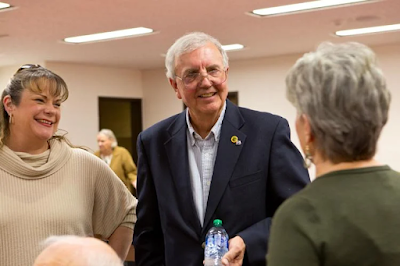
Roanoke County Circuit Court Clerk Steve McGraw celebrates his retirement with family, friends and coworkers at a reception at Roanoke County Circuit Courthouse Friday, Jan. 27, 2023, in Salem.  Scott P. Yates


About 70 people who gathered in a conference room at the Roanoke County Courthouse on Friday counted themselves as friends, family and colleagues of Steve McGraw. The four-decade Democrat has been Roanoke County Circuit Court Clerk since 1992, following two terms on the Roanoke County Board of Supervisors.

His last day in office is Tuesday. McGraw’s resigning and retiring with just under a year left in his term.

Wednesday, his longtime chief deputy, Rhonda Perdue, formally assumes the reins in the clerk’s office, at least through the end of the year. As a Republican, she’s running to succeed him.

McGraw, 72, is backing Perdue wholeheartedly. For that reason, he carefully termed Friday afternoon’s gathering “a transition party” on the emailed invitations, rather than a retirement bash.

“We need to consider the future of this office and her name is Rhonda Perdue,” McGraw told the assembled crowd with utter seriousness. “For the past 26 years, Rhonda has been there to head up, manage and oversee many of our modern initiatives while working her way up to chief deputy clerk starting seven years ago.”

It’s not every day that a Democrat endorses a Republican. In the current environment of deep partisan polarization, such an endorsement can easily be seen as an unforgivable act of political heresy.

But there’s another way to look at it, too.

Isn’t it possible that, after working alongside Perdue for more than 25 years, McGraw believes she’s the best person for the job? And that he’s more concerned the office he’s exiting operates fairly and efficiently than he is about the political party of the person in charge?

That’s the kind of person voters often say they want in office — someone willing to rise above partisanship, to do the right thing.

On Saturday, McGraw told me: “She’s the best possible person to take my place in that office. That’s all I care about.”


Before he got involved in politics, McGraw wore a number of different hats.

He grew up in Roanoke’s southwest quadrant, in the shadow of Virginia Heights Elementary school. He graduated from Patrick Henry High and later Virginia Tech. Even later, McGraw earned a master’s degree.

For a spell he worked as a plumber’s helper; in another job he managed home deliveries of this newspaper.

At some point after college, McGraw spent three years as a social worker in child protective services. On occasion, tragedies he witnessed during that day job left him sleepless and emotional at night.

In the early 1980s, McGraw owned a bar on West Main Street in Salem, The Barrel House. (Awful Arthur’s restaurant is in the same location now.) And he sold real estate as an agent and broker.

All those endeavors brought him into contact with a wide range of people. So did his deep and longtime involvement with the Roanoke Kiwanis Club. Many of his closest friends are members, too.

McGraw’s first venture as a political candidate was an independent bid for the Catawba seat on the Roanoke County Board of Supervisors in 1979. He lost that election. But later, as a Democrat, he won it in 1983 and again in 1987.

McGraw considers former state delegate Dick Cranwell of Vinton his political mentor. Cranwell recalled McGraw’s losing 1979 race as “the scraggly kid from Catawba area who was going to take Roanoke County by storm.”

Today, “I’d say he’s one of the best retail politicians I’ve ever met,” Cranwell told me. “He gets out and meets people from daylight to dusk. He’s as refined and skilled a political operator as they come … And he’s a genuinely good human being. I think that came across in retail politics.”

“He’s a fighter,” said Dave “Mudcat” Saunders, another longtime McGraw associate. “Hell, he’s got three black belts in Taekwondo.” Saunders added: “He’s also one hell of a family man, and about as gracious a guy as you can find.”

As county supervisor, McGraw formally opposed consolidation of Roanoke and Roanoke County, which county voters vehemently shot down in a 1990 referendum. Nevertheless, among his accomplishments were city-county cooperative ventures that seemed to make sense.

One was the development of the Smith Gap Landfill. Another was a local agreement among valley governments that allowed police to chase suspects into neighboring jurisdictions.

McGraw also championed construction of Spring Hollow Reservoir. To strengthen the valley’s water supply, it was later merged into the Western Virginia Water Authority, another example of city-county cooperation.

In 1991, McGraw challenged then-incumbent Circuit Court Clerk Elizabeth Stokes, a Republican seeking her fourth term in office.

The clerk’s post seemed attractive for a number of reasons. One of them was its eight-year term, the longest in American politics. Another was the not-insignificant annual salary (now $147,200).

But as that October came around, internal polling by Democrats suggested Stokes would cruise to reelection.

Three weeks before Election Day, McGraw leaked a state auditor’s report to this newspaper. It had quietly come across his supervisor’s desk months earlier. It found financial mismanagement in the clerk’s office under Stokes, though not to a criminal extent. Local TV stations picked up the story and ran with it. That was unusual in a clerk-of-court election.

Stokes fought back, but oddly. Publicly, she compared McGraw to Anita Hill, a whistleblower who earlier that year had testified to Congress that Supreme Court nominee Clarence Thomas sexually harassed her. On any number of levels, the comparison was a wild stretch.

Ultimately, voters in Republican-dominated Roanoke County put McGraw in office by a few hundred hundred votes. He’s been Roanoke County Circuit Court Clerk ever since. (He squeaked to victory in his last election, in 2015, by 37 votes.)


At Friday’s party, McGraw was humble. He told the crowd his success was due to the large number of friends, family and acquaintances who had backed him over the years. Basically, he meant the people who were in the room.

“The old saying that ‘it takes a village’ could not be truer when applied to my career, beginning with those early days in 1979,” McGraw said. It began with “my first and always my most ardent supporter, my wife Sharon. … From that we developed a really strong cadre of volunteers over the years.”

The couple has two grown sons, Steven and Robert. The former lives here in the valley with his wife, Kelly, and their daughter, Penny. Robert McGraw is married and lives in southern Maryland.

Sharon McGraw, a social worker in Roanoke, is retiring as well. Leaving the rat race will give both a chance to spend longer periods in Florida, where they own a condo near Daytona Beach.

They’re keeping their home in Catawba, though, and will be back a lot, visiting their granddaughter.

“I can’t say ‘thank you’ enough to my village, to my co-workers, or to the voters of Roanoke County,” McGraw said. “It’s been quite a ride.”

-- Dan Casey, Metro Columnist for the Roanoke Times

Sunday, July 19, 2020

New Shoes for Easter! by Steve McGraw

New Shoes for Easter!
by Steve McGraw

Looking back some sixty years, I now realize that growing up in the Roanoke Valley of Virginia in the 1950’s and 60’s could have resembled those scenes of American families as depicted in classic Norman Rockwell paintings unless, like us, you had very little money.  So, to be completely honest, our lives were more like those we saw in the old “Little Rascals” TV shows where most people – and especially the kids – were poor and always trying to figure out how to make the most out of whatever was available.

One year, the consequences of our frugal lifestyle came into play beginning with the important event of attending the annual Easter service at Connelly Memorial Baptist Church.  My older brother, Tony and I really got dressed up, struggling with stiff, button-up shirts whose tight collars seemed too small for clip-on ties, and included wearing shiny black lace-up shoes on that special day.  Unfortunately, I had experienced a typical pre-teen growth spurt and discovered that I had outgrown the previous year’s Easter shoes at the worst possible time; Easter Sunday morning.

Fortunately, there was a Pic-Way Shoe Mart on our way to church and it was open on Easter Sunday mornings – a rare and amazing coincidence!  So, frantically, my father, mother, brother and I all piled into our ’57 Chevy, zoomed down Norwich Hill, flew across the little bridge over the Roanoke River, beeped the car’s horn repeatedly as we navigated through the Shaffer’s Crossing railroad tunnels, and finally skidded into the Pic-Way parking lot as all four doors on our car popped open simultaneously.  Wearing only thin socks on my too-big feet, I dashed into the store with my family and, with help from my parents, quickly found some shoes that fit our price range, shoved them onto my cold feet using a silver shoehorn while my father handed over the cash to the clerk, ran back out to our car and barely made it to the church on time...but I looked quite spiffy in my brand new shiny black lace-up shoes.

Proud of my shoes and very happy with all the compliments that I received on them from family members and friends, I decided to wear them to church each Sunday after Easter.  That worked fine for the first couple of weeks, but one Sunday it was raining really hard, and I wore my new shoes from our house to our car, from the car to the church, from the church back to the car, into my cousins’ and grandparents’ homes and back out to our car, and finally from our car back into our house.

So, when I got home after having done a lot of walking and running in the rain – and maybe a little mud puddle stomping and splashing as well – in my new shoes, I carefully took them off and placed them on newspaper to dry next to our house’s open gas floor furnace grate and turned up the heat.  A few hours later, I was horrified to discover that the shoes’ thin soles had separated into multiple layers of what looked like disintegrating paper, and the bottoms had also separated from their formerly shiny tops.

My shiny new black lace-up Easter shoes were now ruined and unwearable, but what did I expect for $2.00?!

Remembering simpler times. May your new clothes, your new shoes - and especially your fond old memories of days past along with thoughts of better times to come - last you a lifetime!

Steve with Lynne (McGraw) Goroncy from our 2015 Reunion.
Steve won the Visions of West Virginia quilt that Lynne hand crafted as our door prize!

"COLORED Seated In Rear"/Change Needed - by Steve McGraw

Steve McGraw with his wife Sharon in Dungarvan, Ireland
Steve McGraw is the son of Jessie R. McGraw, son of Oza, son of Joel, son of Robert Lee "Jabo," son of John & Mahala. In addition to serving as the Roanoke County (VA) Clerk of the Circuit Court since 1992 Steve is also the past President of the US McCraw Family Association (USMFA). As you may or may not know, John changed his and thus our family name from McCraw to McGraw in the late 1800's. It was Steve's DNA that the USMFA used when it proved our link to the Clan McGrath in Ireland. 

Last summer at the International McGrath Clan Gathering in Dungarvan, Ireland, Steve was awarded with our Clan's highest award, The Medal of Echthighern. The award, was named for our ancestor who was the brother of the Brian Boru who was King of Ireland and is given as recognition for contributions to society and enhancement of the McGrath name.


Steve submitted this lesson he learned about racism from
his father at a very early age, "and it stuck..."


CHANGE NEEDED

It was a glorious mid-morning in the summer of 1955 in the Roanoke Valley of Virginia, and I was about to embark on one of my all-time favorite adventures – riding the bus with my dad at the wheel!  I could hear the bus – my dad’s bus – laboring up the hill and approaching the stop at the corner of Berkeley Avenue and Dudding Street where my mother waited patiently with me while I danced in place beside her. 

At age five, everything was a wonder to me; robins bobbing for worms on the fresh-cut lawns, hummingbirds swooping around flowers, battling each other for sips of nectar, and the distant sounds of Norfolk and Western coal trains chugging along the nearby Roanoke River.   

My mother held my left hand tightly as my right hand gripped a brown paper bag – containing two peanut butter and jelly sandwiches, each expertly wrapped in wax paper – that would be lunch for my dad and me later that day.  How much better could life be?!

Finally, the huge red and white Roanoke Safety Motor Transit Company bus loomed up before me and came to a stop as the accordion doors opened, revealing my dad sitting behind the big black steering wheel, grinning at me and waving me aboard.  

“Come on up, Stevie!” he laughed as my mother half-lifted me up to the first step, let go of my hand and reminded me to use the worn brass handrail as I climbed up the few tall stairs to the top of the landing.

“Back by 4:00?” she asked my dad.

“Yep, see you then…you know what to do, son…” my father reminded me, making sure that I was securely in place behind him on the side-facing seat before he waved at my mother, closed the door, shifted the bus into first gear and expertly balanced the clutch against the gas pedal in order to pull smoothly away from the curb.  Now the adventure began.

In particular, I enjoyed riding up and down the hills, the bus performing like a slow roller coaster, making my stomach feel funny and quickly changing the outside view – sky, trees, roads, buildings, houses, sky...  At the designated stops, whenever there was a future passenger standing in wait, my father would bring the bus to a halt, open the door and welcome each one with a “hello” or a “good morning;” he even knew some of them by name, and some of them knew him, too.  

To the immediate right of the steering wheel was the windowed fare box fitted with four round slots in the top and a hand crank on the side, and passengers would drop special tokens or the correct coins into the box as they boarded the bus.  Occasionally a passenger needed change, and a chrome coin changer was mounted next to the fare box for that purpose, allowing my father to take their bills and give them the coins in return.  In addition, if a passenger had a paper transfer slip, my father would place it on the spindle projecting from the bus’s dash.  It was all very orderly, and the coin changer – where quarters, dimes, nickels and pennies would magically appear from the bottom of each chrome tube with the push of a small lever - was my favorite.    

Steve's Dad's magical coin changer.
When a passenger wished to get off the bus, he or she would pull down on an overhead strap mounted along either side of the ceiling of the long vehicle, making a brief, low buzzing sound at the front of the bus to let my dad know that he needed to stop at the next opportunity.  

This morning, everything seemed to be going fine until the elderly black lady got on the bus.  As she struggled to climb up the stairs while carrying a large shopping bag, my father said the usual hello to her and she responded in kind with a smile, carefully dropped a token into the fare box and then took two careful steps backward to settle heavily into the side-facing seat across from me at the front of the bus.  She nodded and smiled at me, then closed her eyes and appeared to fall asleep almost instantly as my father shut the door and moved the bus on down the street.

A few stops later, a white businessman – wearing a coat and tie and shiny shoes - got on the bus, dropped some coins into the fare box, gave a surprised, stern look to the sleeping black lady, and then whispered something into my father’s ear.  My dad’s reaction was immediate, and it startled me as he half-rose in his seat to most of his 6’4” stature and sharply admonished this new passenger, “If you don’t like it, you can sit at the back of the bus!”

This new passenger was equally startled by my father’s reaction to him, and he hurriedly walked to the center of the bus before dropping sharply into a front-facing seat there.  A few blocks later, the businessman pulled down hard on the overhead cord, creating a long, loud buzzing sound and then released the cord with a snap. 

When my dad brought the bus to a halt, the disgruntled passenger exited from the side door, probably not wanting to walk past my father or the black lady sitting at the front of the bus.  Eventually, the black lady exited the bus in a neighborhood where others like her lived, and the rest of the day went as usual with most of this adventure still being fun for me and my dad.  

When we stopped for a late lunch on a quiet, tree-lined street, the bus was empty and my father moved to the seat across from me as we enjoyed our sandwiches, and dad shared water from his thermos with me.  

Finally, I had to ask the question that had been burning inside me for the past couple of hours; “Daddy, why did you get so mad at that man?”

My father stared at me for several long seconds, probably trying to decide how best to explain the situation to me, and then he pointed at a sign centered up over the bus’s front windshield.

“See that sign?” he asked.

“Yes.”

“It says:  Colored seated in rear…” he explained, “…and the man who got on the bus wanted me to make the black lady move to the back of the bus.”

“Why?” I asked innocently, not understanding the true gravity of the situation until years later, by which time my respect for my parents had continued to grow as I recalled similar memories of my father and mother.

“Ignorance,” my father said.

“What does that mean?” I asked.

“It means that some people think they are better than other people, but they’re not – we’re all the same on the inside…” he said, “…and never forget that, son…”

“OK, daddy.”